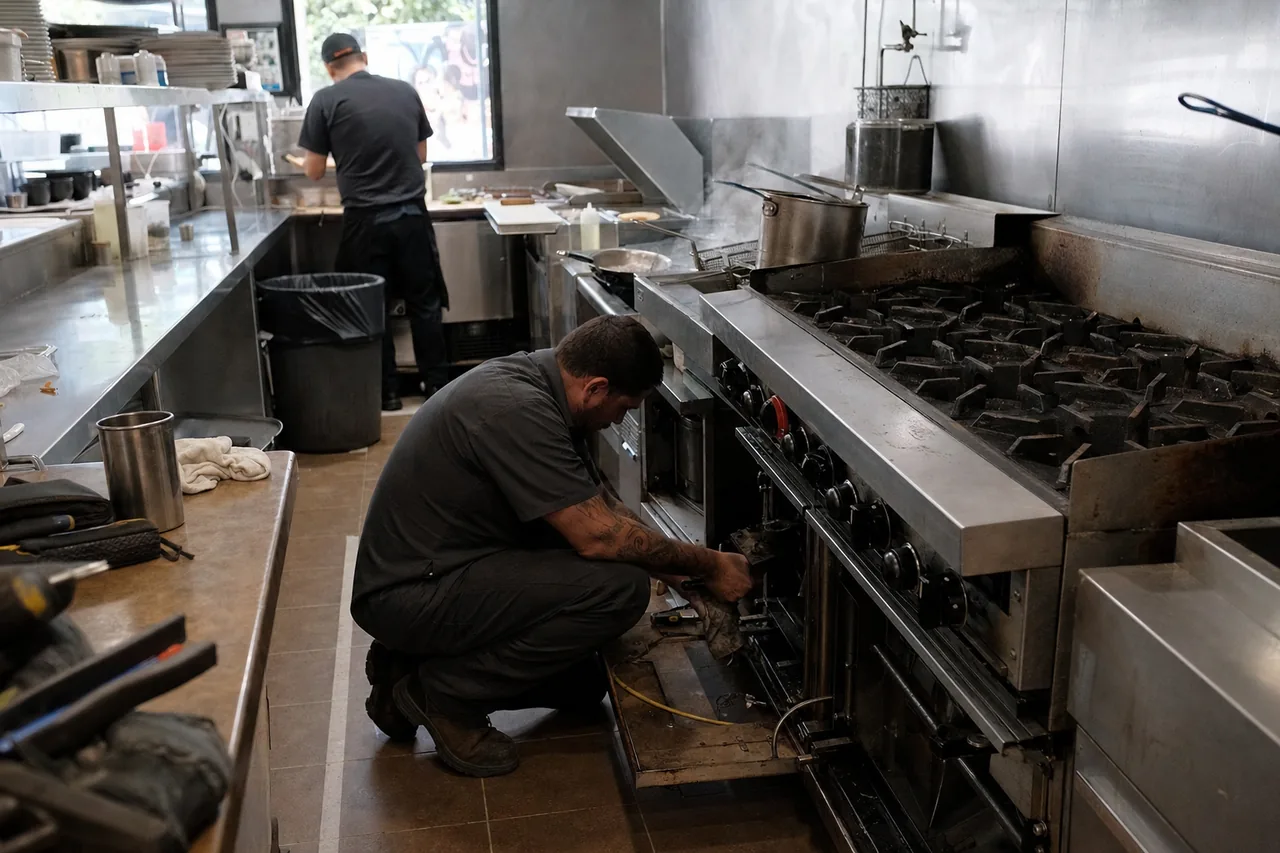
The hood blower had become louder than the range under it. Its wheel was out of balance with grease built up along one side. He removed the wheel, cleaned it thoroughly and rebalanced it on the shaft.
Henrietta L.2026-08-12
Independent Viking kitchen appliance repair · Ponte Vedra Beach, FL
Mon–Fri 8–6 · Sat 9–4 +1 (904) 775-7957
Viking service
Blower motors, remote and inline units, baffle filters, backdraft dampers and the corrosion that salt air brings to a housing three miles from the Atlantic.
Ventilation is the part of a professional kitchen that gets ignored until it fails, and on the coast it is the part that ages fastest. Everything a hood does involves pulling outside air through the house, and here the outside air carries salt.
When a hood stops clearing smoke, the motor is the last thing we suspect. Air volume is lost in this order: loaded baffle filters, a partially blocked duct run, a backdraft damper that no longer opens fully, a crushed or disconnected flexible section above the ceiling, and only then a motor losing speed.
Stainless baffle filters are designed to be washed. They are also designed to be washed regularly — a baffle whose channels are half full of hardened grease can cut airflow substantially while still looking acceptable from below. We measure rather than guess, and part of every ventilation visit is a look at what happens above the hood, which is where most of the losses are.
Make-up air matters too. A powerful hood in a well-sealed modern house has to pull replacement air from somewhere. If it cannot, the fan spins at full speed and moves very little, and the symptom presented to us is “the blower is weak” when the blower is doing exactly what it was told to. The remedy in that case is a make-up air path, which is building work rather than an appliance repair. What we can do is measure it and show you that the hood is not the fault, so nobody buys a motor that was never going to help.
A blower that has become louder without changing pitch usually has an imbalance: grease loading on one side of the wheel, or a wheel that has shifted on its shaft. A blower that whines or growls has a bearing problem. A blower that buzzes at low speed but runs at high speed points at the speed control rather than the motor.
Remote and inline blowers — mounted in an attic, on an exterior wall or on the roof — are common in the larger houses here because they move the noise out of the kitchen. They also put the motor where nobody looks. An attic-mounted blower in a coastal house lives in humid, salt-carrying air with no protection, and the housings corrode from the inside. If your hood is quiet in the kitchen, ask us to look at the blower during the visit even if nothing has failed yet.
Salt aerosol settles on every horizontal surface overnight and gets drawn through the hood as soon as it is switched on. What that does, in order: the filter frames pit, the fasteners seize, the housing sheds its coating, and the motor’s own cooling passages narrow. On outdoor and exposed-lanai hoods the sequence runs several times faster.
The mitigation is not exotic. Wash and dry baffle filters on a routine you actually keep, run the hood for ten minutes after cooking rather than switching it off with the burner, and have the ductwork and blower inspected on a schedule rather than after a failure. Fasteners that are broken loose and re-set once a year come out again next year; fasteners left for a decade in salt air have to be drilled.
Hood lighting and hood motors are usually on separate circuits inside the unit, which is why one can fail with the other unaffected. Halogen lamps in older professional hoods run hot enough to cook the sockets they sit in, and a lamp that flickers is often a socket problem rather than a bulb problem. LED retrofits exist but need a driver that matches the control, and fitting the wrong one produces a flicker at low dim settings that no amount of bulb-swapping cures.
Hood work happens directly above a cooking surface, so we protect the cooktop and the counter before anything comes down. If your hood is over an island with stone returns, or if the blower is remote-mounted, tell us when you book. The diagnostic fee is flat, credited toward the repair, and you get a written estimate before any part is ordered.
Symptoms
What it costs
Flat $80 diagnostic covering the visit and the full diagnostic sequence, credited toward the repair once you approve the work. After that the work falls into bands, and these are the bands that fit this page — parts and labour together, before tax. Nothing above $80 is charged until you have the written figure in your hand and have said yes to it.
| The work | Typical total |
|---|---|
| Diagnostic visit, credited toward the repair | $80 |
| Control board or touch panel | $410–$1,000 |
The spread inside a band is mostly the part, not the hour: the same fault on two machines can want a sensor or a whole assembly. Where a repair would land above $1,000 we say so before ordering anything, and we say it beside what a replacement would cost rather than leaving you to look it up. The full table and what the fee buys, and where a repair stops being worth doing.
Related
$80 flat diagnostic fee, credited toward the repair when you approve the work.
90 days on our labour, 365 days on the parts we supply. Genuine OEM parts.
Questions
Owner feedback
4.2 out of 5 from 80 customer reviews. Each one below is a single visit, written by the person who paid for it. Read all 80.