Wind off the ocean kept pushing air back down the duct. He fitted a proper backdraft damper up at the roof cap and sealed the joint below it. The kitchen no longer smells of the last meal all evening.
Isolde F.2026-07-09
Independent Viking kitchen appliance repair · Ponte Vedra Beach, FL
Mon–Fri 8–6 · Sat 9–4 +1 (904) 775-7957
diagnosis
Airflow is lost in a predictable order: filters, duct, damper, wall cap, make-up air, and only then the motor. Checking it in that order saves a part.
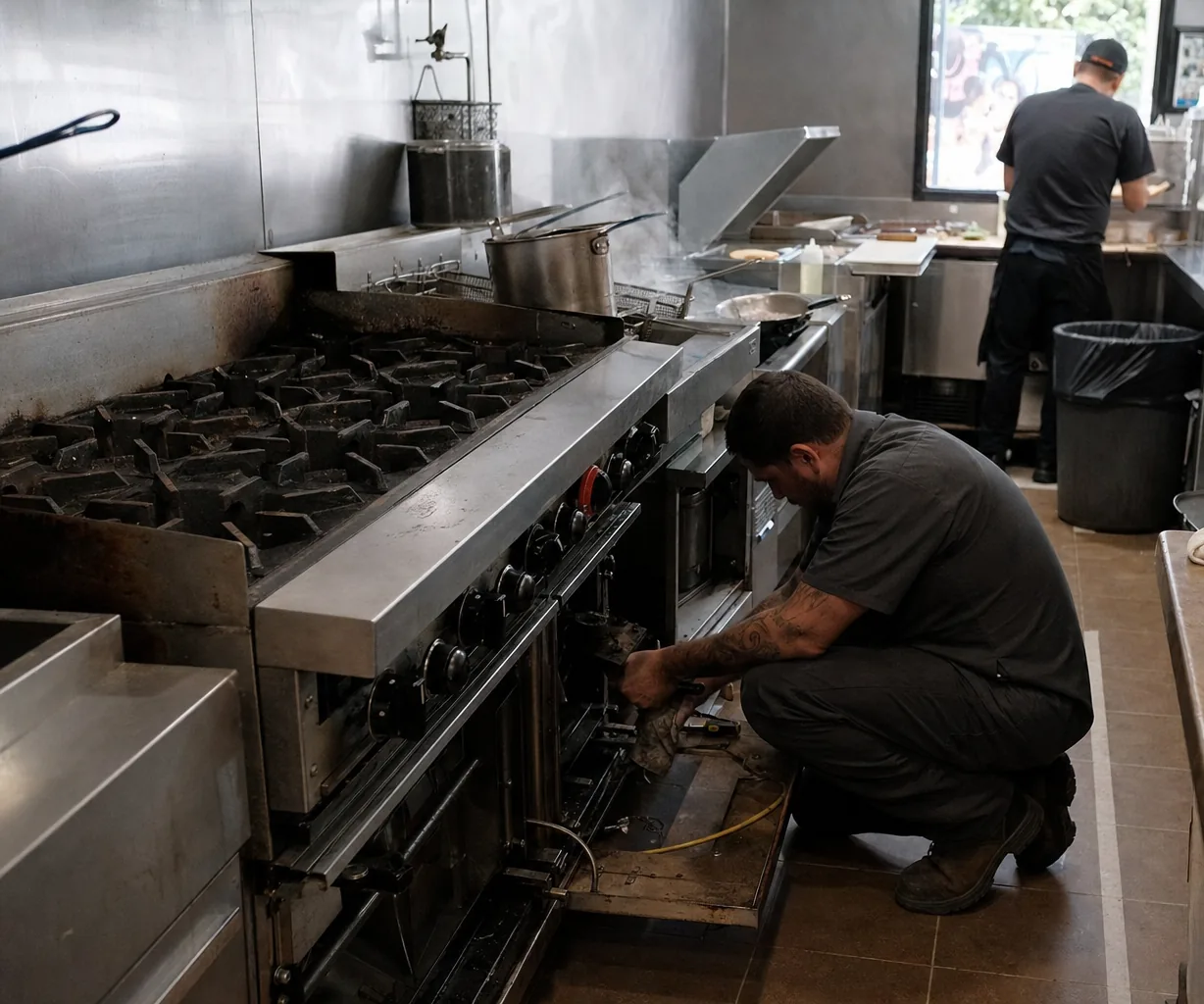
When a hood stops clearing smoke, the instinct is to blame the blower. In our experience the blower is somewhere near last on the list. Airflow in a ventilation system is lost cumulatively, and it is lost in a fairly reliable order.
Stainless baffle filters work by making air change direction sharply so grease separates out and drains. They are designed to be washed, and they are designed to be washed often. A baffle whose channels are half full of hardened grease still looks acceptable from below, because you are seeing the polished face, not the channel.
Take one down and look at it edge-on in good light. If the slots are narrowed, that is your first loss and it is free to fix. Wash them in hot water with a degreasing detergent, or run them in the dishwasher if the manufacturer’s instructions for your hood allow it, and dry them fully before refitting — on the coast, a filter refitted wet holds a damp film against the frame all night.
The duct is the part nobody can see and everybody assumes is fine. Losses live in flexible sections that have been crushed by insulation or a stored box in the attic, in transitions that were reduced in diameter at installation, in long lateral runs with more elbows than the design intended, and in joints that have separated so the hood is partly extracting into the attic rather than outside.
If the hood was fine for years and slowly got worse, a duct that has been disturbed is a strong candidate — particularly in a house that has had attic work done.
There is a damper somewhere in the run, and often a second set of flaps at the termination. Their whole job is to open under airflow and close when the fan stops. Grease stiffens the hinges, and salt air seizes them. A damper that opens halfway costs a large fraction of the system’s capacity.
A rattle in the wind is a useful diagnostic: it usually means the termination flaps are loose or the damper is not seating. Both are worth dealing with, since a damper that will not close lets humid outside air into the duct all day, and on the coast that air is carrying salt.
A powerful hood in a well-sealed modern house has to draw replacement air from somewhere. If the house is tight, and windows are shut, and the air conditioning is running, the fan spins at full speed and moves very little air. This presents exactly as a weak blower and is not one.
The quick check: run the hood on high with everything closed, then crack a window in the same room. If extraction visibly improves, the system is starved and the answer is a make-up air path, not a motor.
Since this note is full of ducts and air, one boundary is worth stating outright. Every run described here is the hood’s own: cooking air, taken out of the kitchen through the roof or a wall cap. None of it is the supply and return ducting that moves conditioned air around the house, and the two systems do not meet. We repair kitchen appliances. Heating, air conditioning, air handlers, thermostats and the ducting that serves them belong to an HVAC contractor, and a make-up air path is building work — we can measure it and show you the hood is innocent, but we do not cut one in.
Only now is the motor worth suspecting, and it usually announces itself by sound rather than by weakness. Louder without a change in pitch is imbalance, often grease loading on one side of the wheel. A whine or a growl is a bearing. Running at high but buzzing at low is the speed control rather than the motor.
Remote and inline blowers deserve a specific mention here. They are mounted in attics, on exterior walls or on roofs, which moves the noise out of the kitchen and moves the machine out of sight. In a coastal house that puts an aluminium and steel assembly in humid, salt-carrying air with no protection. We have opened remote blower housings that were structurally poor while the kitchen end of the system looked new.
Switch the hood on before you start cooking and leave it running for ten minutes after you stop. Grease and moisture that are captured while airborne never land on the housing, the filters or the cabinet fronts. The habit of switching the hood off with the burner is responsible for a large share of the grease loading described above, and grease loading is where the airflow went.
What it costs
Flat $80 diagnostic covering the visit and the full diagnostic sequence, credited toward the repair once you approve the work. After that the work falls into bands, and these are the bands that fit this page — parts and labour together, before tax. Nothing above $80 is charged until you have the written figure in your hand and have said yes to it.
| The work | Typical total |
|---|---|
| Diagnostic visit, credited toward the repair | $80 |
| Control board or touch panel | $410–$1,000 |
The spread inside a band is mostly the part, not the hour: the same fault on two machines can want a sensor or a whole assembly. Where a repair would land above $1,000 we say so before ordering anything, and we say it beside what a replacement would cost rather than leaving you to look it up. The full table and what the fee buys, and where a repair stops being worth doing.
Related
$80 flat diagnostic fee, credited toward the repair when you approve the work.
90 days on our labour, 365 days on the parts we supply. Genuine OEM parts.
Questions
Owner feedback
4.2 out of 5 from 80 customer reviews. Each one below is a single visit, written by the person who paid for it. Read all 80.