Frost kept rebuilding on the rear wall within a fortnight of me clearing it. He tested the defrost heater cold, showed me the open circuit on his meter, and fitted the heater and the bimetal together.
Esperanza D.2026-08-22
Independent Viking kitchen appliance repair · Ponte Vedra Beach, FL
Mon–Fri 8–6 · Sat 9–4 +1 (904) 775-7957
Viking service
Built-in and freestanding refrigeration: temperature faults, defrost problems, ice makers, water inside the cabinet, and sealed-system diagnosis.
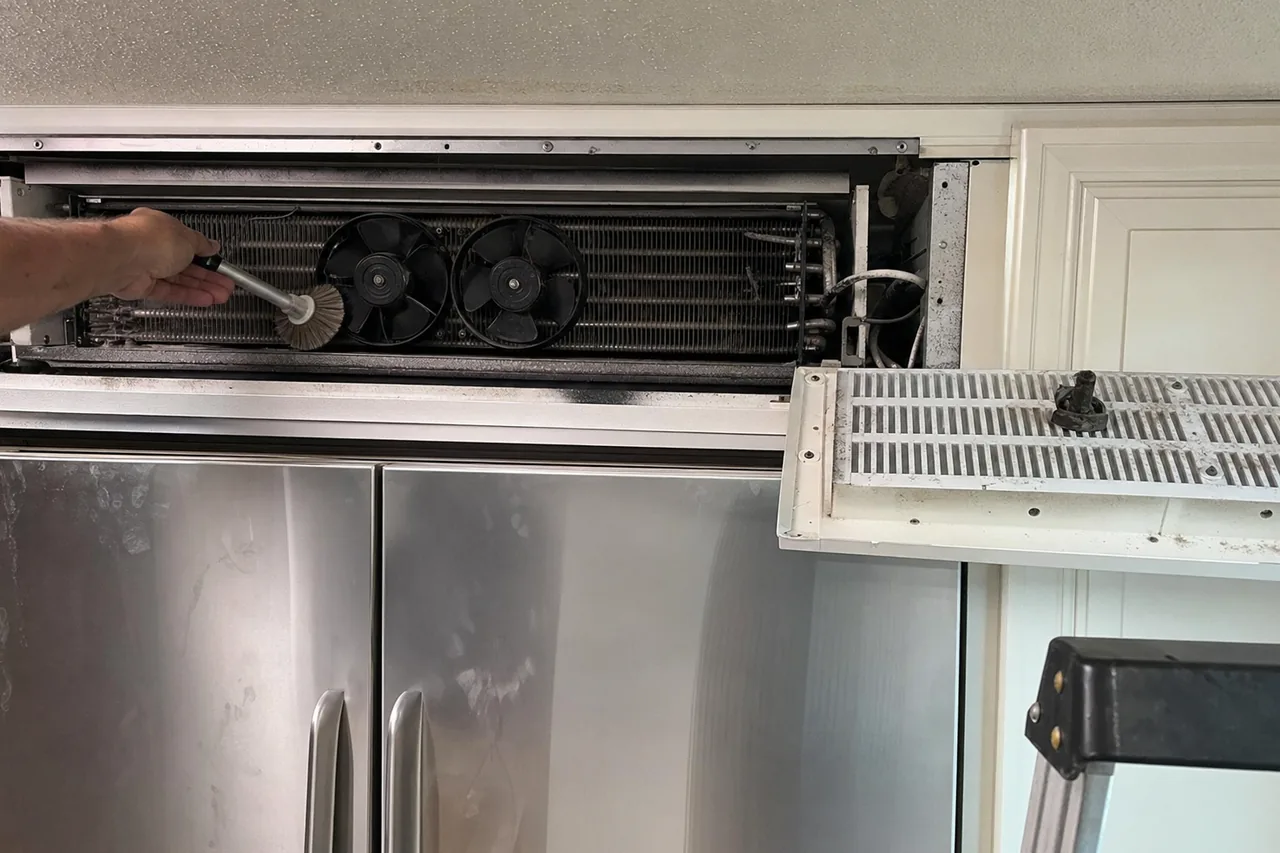
Built-in refrigeration is the most diagnostic-heavy work we do. A warm cabinet has at least six plausible causes, they present almost identically at the door, and only two of them are cheap. Guessing here is expensive, which is why the first visit is a measurement visit.
If the freezer holds temperature and the fresh-food compartment does not, the compressor and the sealed system are almost certainly fine. Cold air reaches the upper compartment through a damper or an air tower, moved by an evaporator fan. When the fan fails, or the damper sticks shut, or the duct ices over, the cold stays where it was made.
We check fan operation with the door switches defeated, then look at the evaporator itself. A coil buried in a solid block of frost is not a sealed-system failure — it is a defrost failure, and the defrost circuit has three parts that can each cause it: the heater, the thermostat or bimetal that decides when to run it, and the control that times it. Testing them separately costs one visit. Replacing all three costs a great deal more.
A refrigerator that runs continuously, holds a cabinet temperature well above setpoint, and has a condenser you can comfortably rest a hand on is behaving like a unit with a refrigerant charge problem. So is one where the evaporator frosts in a partial pattern — a few inches of frost at the inlet and bare metal beyond it.
Sealed-system work is federally regulated. Recovering refrigerant, brazing, and recharging requires EPA Section 608 certification, which our technicians hold. That is a refrigerant-handling credential issued under federal law. It is not a manufacturer credential, and we do not present it as one.
Before opening any system we confirm the basics, because the basics are usually the answer: a condenser packed with dust and pet hair, a condenser fan that has seized, or an air filter and grille that have not been off in five years. On the coast there is a fourth: fin corrosion. Salt-laden air pulled through an aluminium condenser over a decade leaves the fins soft and powdery, and a corroded coil sheds heat poorly no matter how clean it is.
Water inside a refrigerator is almost never a leak from outside the cabinet. It is the defrost drain. Every defrost cycle melts frost off the evaporator, and that water is meant to run down a trough, through a drain tube, and into a pan near the compressor where the heat of the machine evaporates it. When the tube blocks — with debris washed down from the compartment, or with a plug of ice that forms at the coldest point of the run — the melt has nowhere to go and finds the cabinet floor instead.
Clearing it is usually straightforward. Making it stay clear is the part worth attention. A drain that ices repeatedly is often missing the heater or the clip that sits in the trough on designs that have one, or the unit is standing slightly out of level so the trough no longer falls toward the tube. We check level, the trough, the tube and the pan on any call that involves water inside the cabinet, because a pan that has been overflowing quietly leaves its own evidence on the floor behind a built-in.
An ice maker that fills but produces hollow or half-size cubes is usually reporting on something upstream of itself. The fill valve meters by time, not by volume, so a partly closed shut-off, a kinked or crushed supply line, or a cartridge filter that has been in place for years all reduce the water that arrives in the same fixed seconds. Freezer compartment temperature is the other common cause: a mould running a few degrees warm harvests slowly and incompletely. Both are worth ruling out before anyone orders an ice maker assembly, which is the most-replaced and least-often-faulty part in the cabinet.
A refrigerator door gasket is a magnetic seal in a flexible profile. It hardens with age and it takes a set if the door is left ajar under load. In a house that is open to the ocean breeze for half the year, a marginal gasket has a second consequence: humid air entering the cabinet condenses on the evaporator, which makes the defrost cycle work harder, which brings forward every defrost fault described above. Gasket, hinge alignment and door closing force are checked on every refrigeration call, whether or not they are the reason you rang.
Tell us the compartment temperatures as read by a separate thermometer left in the cabinet overnight, not the number on the display. Tell us whether the unit is built-in or freestanding and how it is trimmed, since a fully integrated column has to come out on its rails to reach the machine compartment.
The diagnostic fee is flat and credited toward the repair. You get a written estimate before any part is ordered, and we will say plainly when a unit is worth repairing and when it is not.
Symptoms
What it costs
Flat $80 diagnostic covering the visit and the full diagnostic sequence, credited toward the repair once you approve the work. After that the work falls into bands, and these are the bands that fit this page — parts and labour together, before tax. Nothing above $80 is charged until you have the written figure in your hand and have said yes to it.
| The work | Typical total |
|---|---|
| Diagnostic visit, credited toward the repair | $80 |
| Compressor or sealed-system repair | $890–$2,470 |
| Refrigeration fan or defrost system | $250–$630 |
| Control board or touch panel | $410–$1,000 |
The spread inside a band is mostly the part, not the hour: the same fault on two machines can want a sensor or a whole assembly. Where a repair would land above $2,470 we say so before ordering anything, and we say it beside what a replacement would cost rather than leaving you to look it up. The full table and what the fee buys, and where a repair stops being worth doing.
Related
$80 flat diagnostic fee, credited toward the repair when you approve the work.
90 days on our labour, 365 days on the parts we supply. Genuine OEM parts.
Questions
Owner feedback
4.2 out of 5 from 80 customer reviews. Each one below is a single visit, written by the person who paid for it. Read all 80.