The steam oven stopped filling and flashed nothing useful. He found the inlet screen blocked with scale, cleared it, descaled the boiler and left me a note on how often that needs doing on the water here.
Thaddeus O.2026-03-07
Independent Viking kitchen appliance repair · Ponte Vedra Beach, FL
Mon–Fri 8–6 · Sat 9–4 +1 (904) 775-7957
diagnosis
An oven thermostat test you can run yourself in an hour, what the numbers mean, and where the line falls between a calibration offset and a real fault.
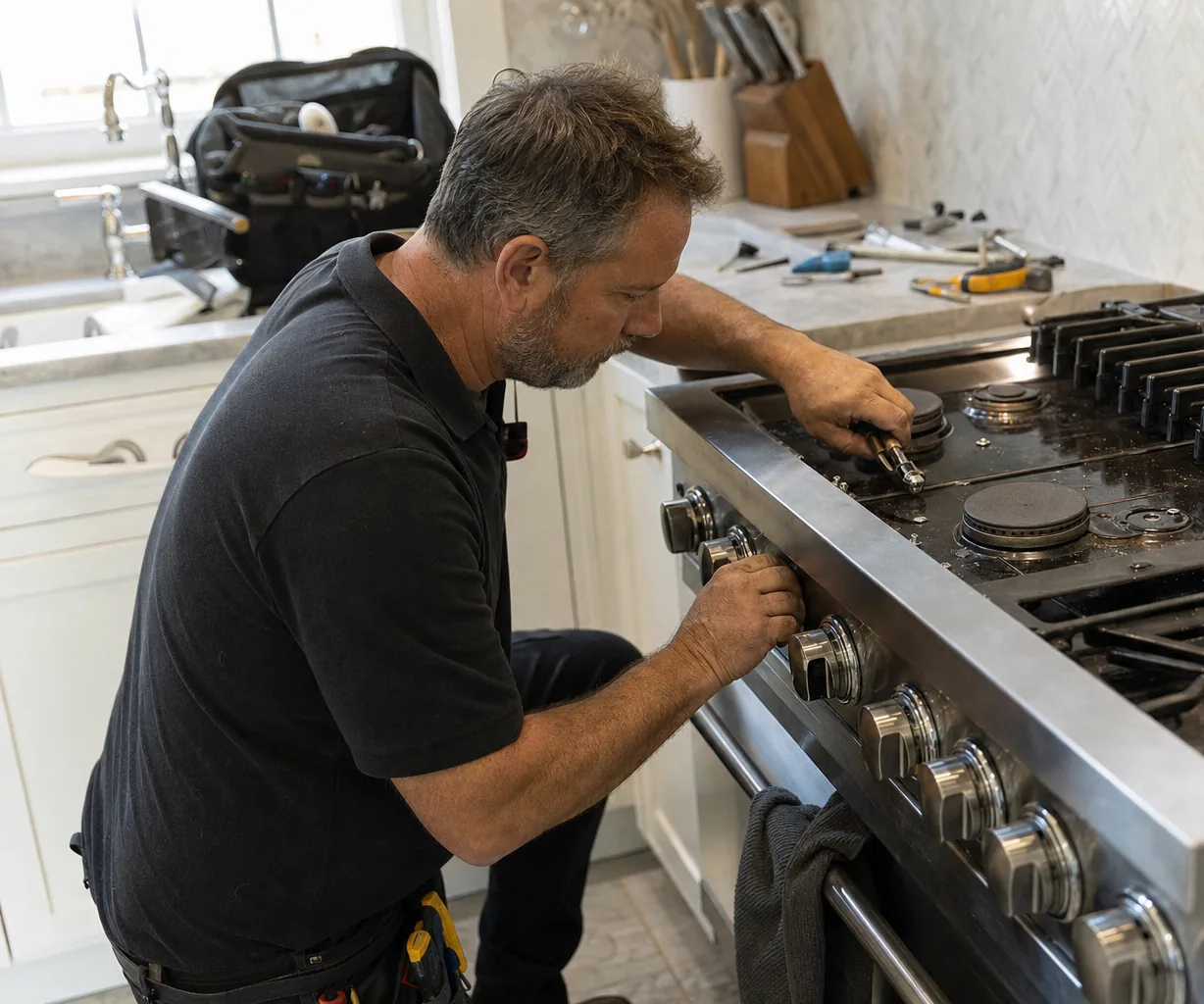
“The oven runs hot” is one of the most common calls we take, and it is one of the few where an hour of your time before the appointment genuinely changes the outcome. The test below tells us whether we are looking at a calibration offset, a sensor, or an element circuit, and those are three different visits.
An oven thermometer that hangs from a rack — a dial or a probe type, either is fine, as long as it is independent of the appliance. Do not use an instant-read meat thermometer; most are not rated for sustained oven temperature and they are not designed to read air.
Put the thermometer in the centre of the middle rack, with nothing else in the cavity. Set the oven to 350°F on a standard bake setting, not convection.
Wait until the preheat signal sounds, and then keep waiting. This is the part people skip. An oven is at its least stable in the first fifteen minutes after preheat, because the walls and racks are still absorbing heat. Give it twenty minutes past the preheat tone before you read anything.
Then read the thermometer every five minutes for half an hour and write the numbers down. You are not looking for one reading. You are looking for a range and an average.
A steady number that is 10–15°F off. The oven is controlling well and simply has the wrong reference. On most Viking ovens this is a calibration offset, and it is adjustable. That is usually resolved inside the diagnostic visit with no parts at all.
A steady number 25°F or more off. Too far to be drift. The temperature sensor is the prime suspect. We measure its resistance cold, then at a known cavity temperature, and compare against the curve it should follow. If the sensor reads true, the control is misreading it.
A wide swing — say 320°F to 390°F around a correct average. The reference is fine and the control of it is not. This points at the sensor’s placement or condition, a control that is cycling badly, or on a gas oven a valve that is overshooting. It is also what a failing door seal looks like, because heat escaping past the gasket makes the cavity chase itself.
A number that climbs and never levels. Stop the test. Something is calling for heat continuously, which is a control or relay fault, and it is not worth running the oven until it has been looked at.
Correct at 350°F, wrong at 425°F. Not unusual, and it tells us the error is proportional rather than a fixed offset — which points at the sensor rather than the calibration.
The door. A wall oven or range door hangs on spring-loaded hinges. When one weakens, the door sits proud at a top corner, the rope gasket stops touching, and heat leaves past the control panel. The oven then reads its own cavity accurately and cannot hold it. Close the door on a strip of paper at several points around the frame; if the paper slides out easily anywhere, look there first.
One-sided browning. If a tray browns on one side, the cavity temperature may be perfect and the problem is air movement — a convection fan that has slowed, or a blocked rear baffle. That is a different repair from anything the thermometer will tell you.
The numbers, the interval, and the setpoint. Three lines is enough: “350 set, readings every five minutes for thirty, ranged 368 to 381, average 374.” That sentence lets us arrive with the right part on the van instead of ordering it after the visit, which is the difference between one appointment and two.
What it costs
Flat $80 diagnostic covering the visit and the full diagnostic sequence, credited toward the repair once you approve the work. After that the work falls into bands, and these are the bands that fit this page — parts and labour together, before tax. Nothing above $80 is charged until you have the written figure in your hand and have said yes to it.
| The work | Typical total |
|---|---|
| Diagnostic visit, credited toward the repair | $80 |
| Oven thermostat or heating element | $190–$550 |
| Control board or touch panel | $410–$1,000 |
The spread inside a band is mostly the part, not the hour: the same fault on two machines can want a sensor or a whole assembly. Where a repair would land above $1,000 we say so before ordering anything, and we say it beside what a replacement would cost rather than leaving you to look it up. The full table and what the fee buys, and where a repair stops being worth doing.
Related
$80 flat diagnostic fee, credited toward the repair when you approve the work.
90 days on our labour, 365 days on the parts we supply. Genuine OEM parts.
Questions
Owner feedback
4.2 out of 5 from 80 customer reviews. Each one below is a single visit, written by the person who paid for it. Read all 80.